Touring the Two Gardens

Touring the Two Gardens
Both of these private gardens can be visited by groups from two to twenty. Contact Moria at moriainsantafe@yahoo.com for information. Click on the photo here to go to the TP blog.
Showing posts with label early spring. Show all posts

Wednesday, April 28, 2010

Late March in the High Desert


After a long, snowy winter, spring finally began to overtake winter in the very last week of March here in Santa Fe. The Crocus and Iris reticulata were the earliest blossoms, along with hellebores and chionodoxa.


With the weather too chilly to start seeds outside, we turn to the greenhouse to jump start the garden. Here Dahlia has sown lettuce seeds thickly, and then transplants to one or two per pot when the first true leaves appear. This technique is useful when working with older seeds of uncertain viability. The little transplanting tool shown is perfect for moving delicate seedlings. The key to success in transplanting is to use a gentle hand!


Mrs. B purchased this light bench a few years ago and it is just wonderful! The lights can be easily raised and lowered. It's on a timer to optimize the light.


Just after sowing, I like to cover the trays with clear plastic wrap. This keeps the soil evenly moist, especially important with tiny, surface-sown seeds. Once the plants have sprouted it can be removed.


Watering tiny plants is another delicate operation. I try to just dribble water around the plant without actually hitting it. These seedlings are in 2" pots, which will be adequate up until it's time for them to go into the ground.


Even better than plastic wrap is a flat with a clear raised cover. These keep the plants in a higher humidity than we have, even inside the greenhouse. Many plants benefit from this environment, but they must be gradually hardened off to accept the harsh reality of outside life.


At LQ the greenhouse also serves to overwinter many of the tender potted plants which are placed around the garden after all danger of frost has passed.
Unfortunately, in spite of our most diligent efforts, by spring we invariably have insect pests in the greenhouse. The populations of aphids and white fly, as well as scale and mealy bugs, soar once the spring sunshine begins to warm the greenhouse. Air circulation, yellow sticky traps, and hand-picking are the controls we've used. This is usually enough to keep the seedlings safe from attack, but we have had trouble with a few particularly delicious crops.


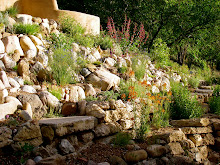
The rock garden is one of the earliest places to color up in the spring. Rocks store and reflect heat, giving nearby plants a bit of an edge.


Helleborus species have received a lot of attention from plant breeders lately, resulting in glorious early blooms for our gardens. These tough survivors do surprisingly well here, as they tolerate alkaline soil, drought and cold.


What more could we ask for?  The bees certainly appreciate it!


Brilliant yellow crocus brighten the garden in early spring, a promise of the wonders to come.


Chionodoxa carpet large areas beautifully, increasing by seed and bulbils annually.


The earliest daffodils are up, trumpeting revelie to the rest of the garden.


Another lovely crocus; I believe this one is called "Lady Killer". Works for me!


As I walk around to the north end of the property, I find that the snow still lies deep.


Yet even on the cold side of the garden, I discover delicate Iris reticulate varieties popping up in sunny spots.


The Iris is a wonderfully varied genus, and plant breeders have added countless variations to the different species. It's easy to find a spot for these tiny early marvels.


Here another delicious crocus positively glows with radiant beauty. All this is just the beginning of what is proving to be a most wonderful year in the gardens at LQ.

Thursday, November 12, 2009

Fruit trees in Santa Fe

Santa Fe is high and sunny, which makes for a pleasant four season environment, but causes problems for fruit trees. The intense sunlight can trick the trees into blooming much too early. Then a cold snap or snow is bound to come along and kill the poor innocent little blossoms, leaving us with no fruit! This picture was taken on April 2, and the apricot , always adventurous, is already starting to burst into bloom.

Here is the grand old apricot at LQ, a week later, in full, glorious bloom.
That same year, at TP, the apricot in front of our house has already had its blossoms blasted by freezing night time temperatures. But as long as some buds don't open until after a killing frost, there is still a chance for fruit. The blooms which are turning brown had frozen, but new ones open each day. Hope springs eternal!

But that night it snowed, and the blooms were burdened with an inch of snow the next morning. No fruit again!

Two days later we got yet another snowfall. Don't get me wrong; I love spring snows...we always need the moisture! But we've yet to pick a single apricot from this tree, and it's 11 years old! The problem is the placement. It is on a south-facing slope. This means it gets a lot of direct winter sunshine, and blooms earlier than it should. Best to place early bloomers on a north-facing slope or on the north side of a building to avoid this problem.

And here is another beautiful show on April 16th of crabapple blossoms. Some trees seem more tolerant of cold than others. We always get crabapples!

Pruning Fruit Trees

I am no expert on fruit tree care, but local nurseryman Gordon Tooley of Tooley's Trees is. I attended a very good workshop he gave a couple of years ago in early March on pruning, and I thought my photos from that day would provide some useful illustrations for a winter task which many find confusing.

In this shot we see a young tree, probably about three years old. It has already been pruned the year before for shape. Take note of the angle of the branches; they spread out from the trunk with a wide angle. Just three or four well-spaced main branches is desirable. However, the water sprouts from the base of the tree must be removed.

Gordon held onto every little branch he cut, rather than dropping them on the ground. Between trees he sprayed his pruners with a bleach solution he carried in a spray bottle. All this was for disease prevention. The pruned branches could be used for grafting if one was that ambitious.

He pruned to open up the interior of the tree, and to eliminate crossed branches. As a rule of thumb, there should be room for a bird to be able to fly through a fruit tree without brushing its wings on the branches. Fewer branches means that the tree sends more energy to the fruit, so it gets bigger. It also means better air circulation for disease resistance, and facilitates harvesting.

Where three branches emerged from one point he has cut one out to leave the two which were the best placed. Note that the cut is near the trunk. A well done cut like this is placed barely outside of the ring at the base of the branch. This ring, if left intact, will continue to grow, allowing the tree to seal the cut over time. He also removes branches growing at too tight an angle, which would result in a weak joint that could later break under the weight of the fruit.

Here's an example of a poorly done cut from the year before. It was made too far from the trunk, and the bark peeled away as well. These flaws are the result of hurried, careless work, or a lack of knowledge. Such mistakes can open the tree up to disease. A cut like this can lead to heart rot and shorten the life of the tree. Look for the "dotted line" that shows you where to make your cut.

Here's a well-established orchard which had been neglected for many years. The trees have become overgrown and are now producing undersized fruit. They need thinning to return to productivity.

Originally this tree was pruned properly, and has a nice shape, but it needs a good thinning to restore it. A bird would have a tough time flying through that tangle! A stricter standard calls for being able to throw a cat through the branches...must've been a cat-hater that came up with that one!

Here you can see water sprouts which were allowed to grow. Obviously, even if you wanted to keep some to fill in a hole, there are too many for the tree to support. Suckers like these can rob the older well-placed branches of water and nutrients, and will eventually take over.

Timing is important for pruning. Late winter is a good time, as disease organisms are dormant and not liable to get into the cuts. The lack of leaves makes the branch structure obvious, and eases the entire process. However, winter pruning does cause sucker growth.

One of Mrs. B's favorite quotes from one of the English garden writers she loves (sorry I've forgotten which one) is "growth follows the knife". It's quite true. Whenever you prune you are liable to stimulate a reaction in the tree to produce more vegetation. This is a survival mechanism, to tolerate browsing by herbivores. It hasn't been long since trees had BIG herbivores with which to coexist and coevolve (giant ground sloths...think about it!). But if we prune we need to continue maintaining the trees to optimize their form for production.

Wednesday, November 4, 2009

Unusual species tulips at LQ

I'm not sure of the identity of this diminutive species tulip. Can anyone help?

Another unidentified shortie. These were probably all purchased from McClure and Zimmerman, so I can figure it out by reading the catalog descriptions. This is where good permanent labels are valuable, or good mapping and organizational skills. I confess, this is part of why I am blogging: to make up for my lack of the above!

Tulipa tarda with Scilla siberica makes a nice combination. Both are from central Asia.
Tulipa saxatalis is from Crete. As you can see, many of these blbs come from dry, rocky places. They appreciate a place that bakes in the summer.

Tulipa clusiana is a tall, graceful beauty native to Iran. Who knew?

We planted quite number of species tulips in the rock gardens at LQ. This charming little one looks like Tulipa fosterana, which originates in Central Asia. The higher elevations of the Southwest US have much in common climatically with that region. We order species tulips from McClure and Zimmerman, since they propagate their bulbs, rather than collecting from the wild. Such collecting can have devastating impacts on wild populations, and we need to avoid purchasing from any company that does it.

Old Reliable

Tired of flat tires, broken handles, and cheap fittings that don't hold up? Just get one of these! My husband's grandfather's wheelbarrow, with its metal wheel, has never failed us. It sits outside year-round and gets zero maintenance. Good luck finding one, though...it has to be almost 90 years old! They just don't make 'em like they used to!

Color in the early spring at TP

Here are English Violets and Aubrieta, both hardy perennials which tend to self-sow where happy, like the rock garden. Aubrieta is easily grown from seed, but little seen in this country. I bought seed many years ago from Chiltern's...a wonderful seed company out of England. The violets are fragrant and will rebloom in the fall. They make a delightful nosegay!

Exquisite!

Kaufmanii tulips are among the earliest bloomers, and tend to multiply.

Before they even begin to flower, some Greigii tulips sport beautifully patterned foliage. Their big, bright flowers only add to the show.

Red Hens and Chicks (Sempervivum tectorum rubra) fill a crevice with color all year long. Many succulents have colorful foliage through the winter and are hardy and xeric. These plants are also called House Leeks, referring to their traditional use as a plant grown on green roofs, a function for which they are admirably suited.

Sunday, November 1, 2009

The variety of bulbs at LQ


This is Tulipa turkestanica, an unusual, graceful little species tulip with the delightful habit of self-sowing where happy. The seed heads are decorative as well, so you won't mind letting it stay to ripen and drop its seed in the garden.

Chionodoxa Luciliae, Glory-of-the-Snow


By early April many more bulbs are emerging. These plants have a neat system of storing enough energy in a bulb to estivate (go dormant) in the heat of summer, as well as being able to survive frigid winter conditions. It is not surprising to learn that many of our familiar bulbs originally evolved in areas quite similiar in climate to that of New Mexico. The Caucasus Mountains, The Arals, The Drakensbergs all have native species which naturalize very well here.

Subtle beauty in March


Here is Crocus chrysanthus "Blue Pearl", a particularly ethereal flower, which glows in the reduced light of late winter/early spring.

Another lovely crocus


This one is Crocus vernus. I love flowers which display contrasting veins.

Early crocus brighten the dormant garden


Here is Crocus chrysanthus "E.P. Bowles", already starting to fade when this shot was taken on March 14th.

Early spring at LQ


The first bulbs appear as early as February. Tiny Iris reticulata is usually the first one to pop up through the snow. I like to place them near a path, against a rock where they will be appreciated. This picture was taken on March 6th.

Saturday, October 31, 2009

Transplanting onion seedlings


Here is the awesome vegetable gardener at LQ, Dahlia, transplanting onions seedlings into the garden. If you want to save onions through the winter, it is important to grow them from seedlings, not sets. Seedlings can be purchased from several seed companies (of course I like getting organic ones from Seeds of Change!), or you can grow your own. I start onion seeds in 2" pots in late January or early February in the greenhouse. They can be grown in groups of three or four without thinning; in fact they like to be a bit crowded! New Mexico has a great climate for growing onions and it is a reliably successful crop at both gardens.